A published trial of an autonomous urban ferry still leaves stated decisions with people on board and, in later demonstrations, with people at a shore centre. That is what Zeabuz’s own pages on MF Estelle say, and it matches the International Maritime Organization’s MASS framing that a ship can be remotely controlled while seafarers remain on board. It is not the same claim as a ship moving among other traffic with nobody responsible. Where a page does not say Estelle is unmanned in every meeting with other craft, that idea stops being a description of this ship.
Right for this job: Reading a named operator trial (MF Estelle) and IMO MASS wording to see which human roles the pages still name—crew or operator on board, remote operations centre, human master.
Wrong for this job: Treating a demonstration headline as proof that the next ship in traffic is unmanned, or inventing duties the opened pages do not assign.
The number that decides it: Not a single autonomy score on the Estelle pages opened; what decides the reading is whether the operator page names crew on board, a remote centre, or both for the phase described.
What the spec leaves out: A blanket claim that Estelle already sails every urban meeting with no person responsible; Zeabuz’s launch facts describe crew onboard for the first phase and an aim of later unmanned service with onshore supervision.
Check before you rely on it: Who the operator page says is still in the loop for that voyage or phase—onboard operator or crew, remote operations centre, or “not stated.”
Last checked: September 29, 2026
What the measurements, the plan, and the person ashore are doing
On Zeabuz’s technology page (opened September 29, 2026), the company describes its autonomous navigation stack as a continuous loop: Sense, Comprehend, Plan, Act, Supervise. Sense, as that page names it, is a suite of sensors observing the vessel’s surroundings; the same page states that Zeabuz currently employs off-the-shelf radar, lidar, cameras, and AIS so object-detection algorithms can identify relevant objects nearby. Comprehend is situational awareness built by combining detections. Plan is dynamic path planning based on that awareness and the vessel mission. Act is motion control that follows setpoints from the planner. Supervise is the human–machine layer that, in Zeabuz’s wording, enables operational modes with a combination of crew onboard and onshore.
Those names matter because they keep three jobs separate. Sensors are measurements of what is around the ship, as the technology page describes them. A plotted route—or, in Zeabuz’s planning language, a dynamic path tied to a vessel mission—is a plan for where the ship is meant to go, not a photograph of every craft that may appear. A remote operator is a person off the ship: Zeabuz’s November 2024 award page states that an autonomous ferry crossing was managed and monitored remotely from a Remote Operations Center (ROC) in Trondheim, Norway, about 600 kilometers from the Stockholm service. The technology page separately defines remote supervision as high-level remote control of an autonomous system—monitoring operation and intervening only if necessary—and remote control as conventional manual vessel control performed from a remote location. This article does not describe how to change those controls.
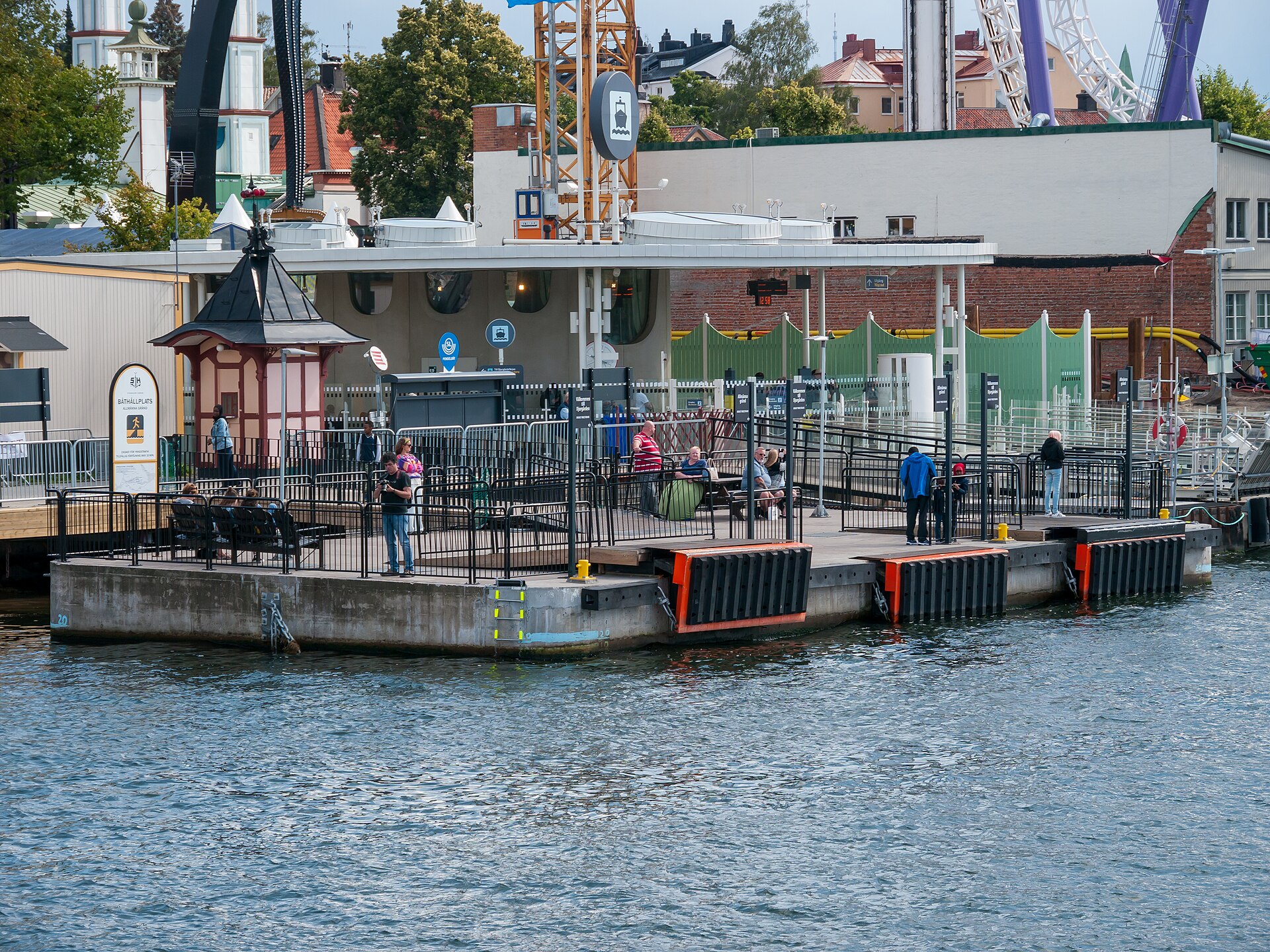
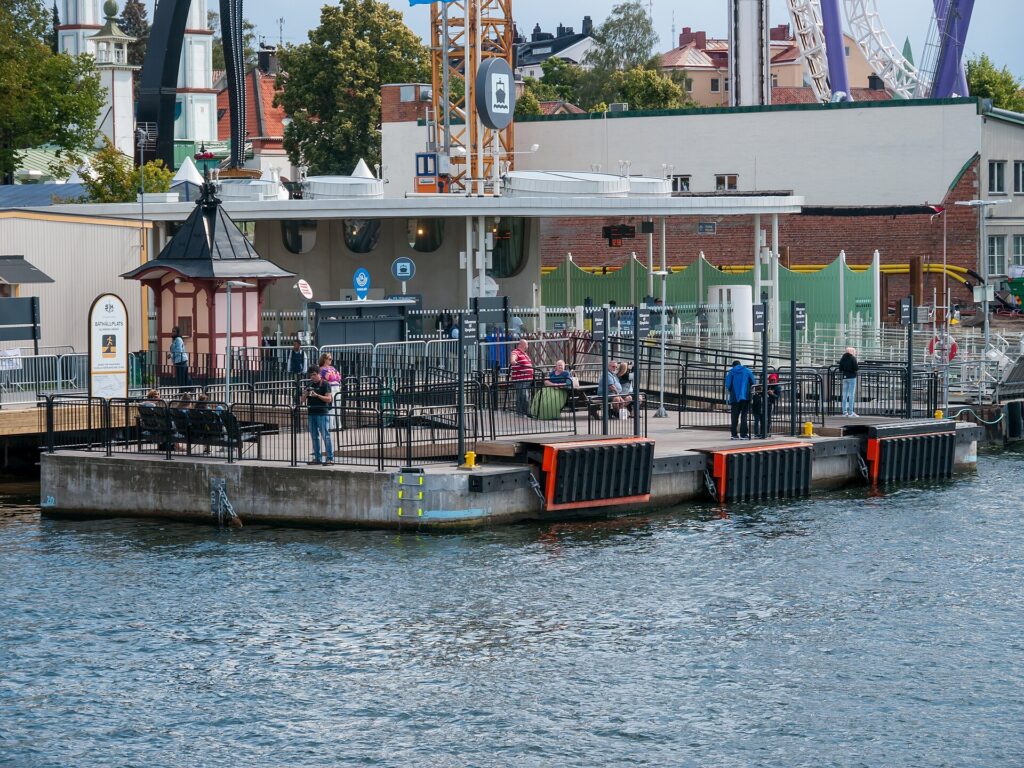
MF Estelle is the named ship behind those demonstrations. Zeabuz’s June 2023 launch page states that the ferry line runs between Södermalm and Kungsholmen in Stockholm, with capacity given as 24 passengers per trip and up to 120 daily trips. The same page says the electric and autonomous ferry will provide the service with the crew onboard for the first phase of the operation, and that the aim is to serve the ferry line unmanned and with onshore supervision in 2024. Elsewhere on that page, Zeabuz’s CTO is quoted that Estelle will initially have an operator on board, with the ultimate goal of becoming fully self-driving and monitored from the shore. Those sentences are phase descriptions and aims. They are not a statement that every traffic encounter on the line already happens with an empty deck.
The International Maritime Organization’s May 2018 press briefing on MASS (opened September 29, 2026) defines a Maritime Autonomous Surface Ship, for the regulatory scoping exercise, as a ship which, to a varying degree, can operate independently of human interaction. The same briefing organizes degrees of autonomy non-hierarchically. One degree is a ship with automated processes and decision support, with seafarers on board to operate and control shipboard systems and functions, and with some operations possibly automated. Another is a remotely controlled ship with seafarers on board: the ship is controlled and operated from another location, but seafarers are on board. Another is remotely controlled without seafarers on board. Another is a fully autonomous ship whose operating system is able to make decisions and determine actions by itself. The briefing notes that a MASS could be operating at one or more degrees of autonomy during a single voyage. Estelle’s operator pages describe crew or an operator on board in the first phase and later remote management from a ROC; that combination sits nearer the “remote with people still named” side of IMO’s wording than a claim of full independence from human interaction in all traffic.
IMO’s non-mandatory MASS Code (resolution MSC.595(111), adopted 21 May 2026; text opened September 29, 2026) defines a Remote Operations Centre as a location remote from the MASS from which some or all of the functions of the MASS can be operated, and a remote operator as a qualified person employed or engaged to operate some or all of those functions from a ROC. In the Code’s human-oversight provisions, onboard crew and remote operators responsible for managing MASS operations should be able to exercise human oversight and control, including understanding system outputs, supervising and verifying system-initiated decisions as appropriate, and intervening or overriding if required. The same section states that there should be a human master responsible for a MASS, regardless of the mode of operation, and that the master should have the means to intervene when necessary. Those are Code requirements written for MASS operations under that instrument—not a restatement of Estelle’s day-to-day roster—but they show how public regulatory text still keeps a human master in the description.
Why a demonstration on a stated line is not every meeting at sea
A published trial fails differently from open traffic because the trial page describes a bounded service and a named manning arrangement for a phase. Estelle’s operator facts name a city line between two Stockholm districts, a passenger capacity, and—for the first phase—crew or an operator on board. A later Zeabuz page names a remote operations centre managing and monitoring a crossing from hundreds of kilometers away. That is a demonstration story with stated people and a stated route. It is not automatically a claim about every meeting with another vessel on every waterway, under every weather state, with every other craft behaving as expected.
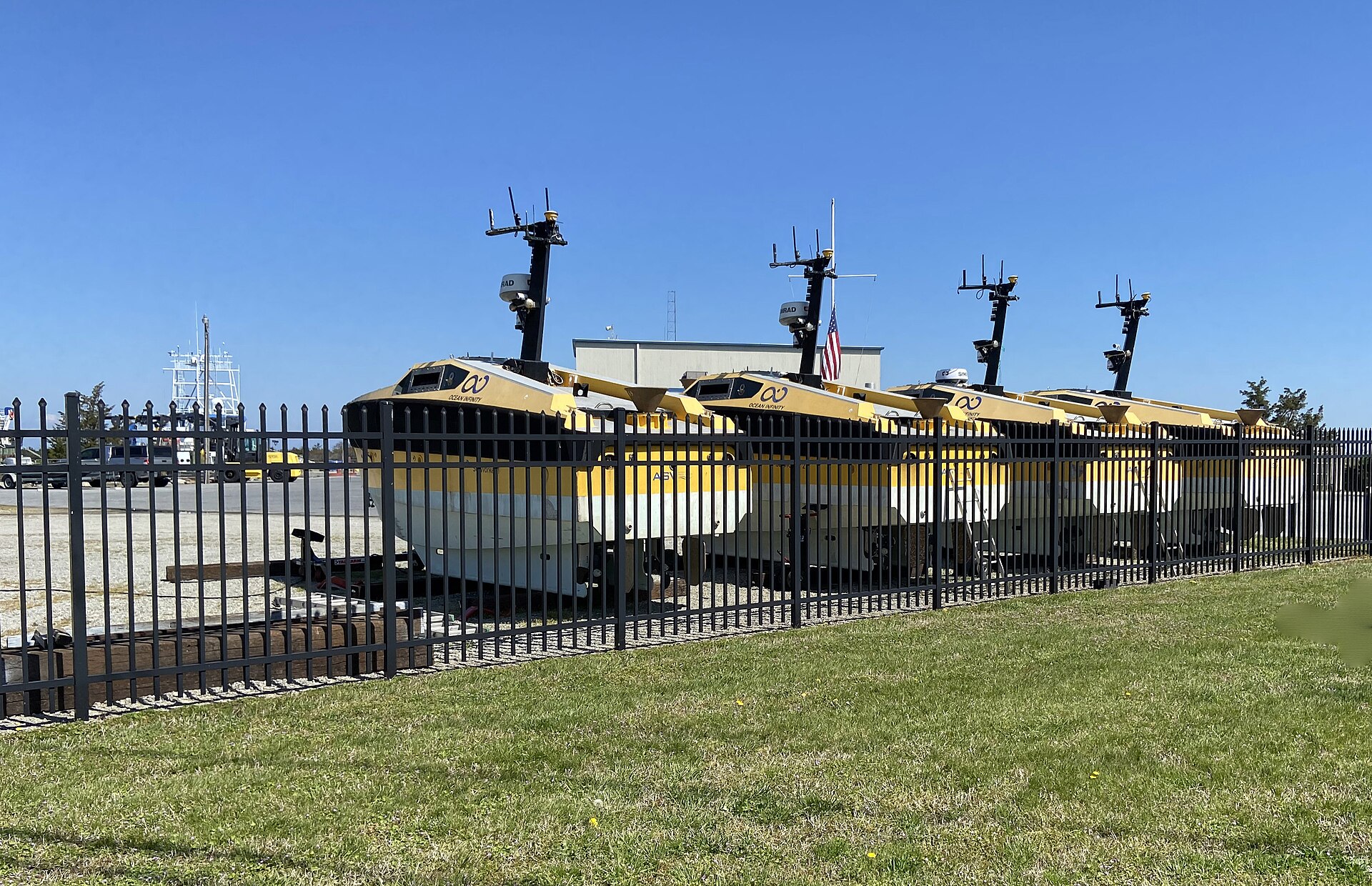
Other traffic is not fully on an AIS screen. That is the point of What AIS tells you about another vessel, and what it never will: a list of transmitters is not a census of everything afloat. A charted or planned path is also not the same thing as a radar return from another vessel—the high-level split named in What marine radar shows that the chartplotter does not. Zeabuz’s technology page lists AIS among the sensors its stack can use, alongside radar, lidar, and cameras; that product description does not erase the sibling-article point that an AIS target list is still only what is transmitting and received. None of that comparison is a set of collision-avoidance steps for operating the ship. It is only why a trial that follows a published line under stated supervision is a thinner claim than “the sea is empty of responsibility.”
Zeabuz’s own technology page draws a related distinction in plain language: autonomous navigation, remote control, remote supervision, and unmanned or uncrewed operation are not one and the same thing. The page states that an autonomous vessel may also be uncrewed, but that one should also expect fully or partially autonomous vessels with lean crew, and uncrewed vessels that are only remote controlled and not autonomous. Reading Estelle’s launch wording through that lens keeps the first-phase crew onboard separate from the later aim of unmanned service with onshore supervision, and separate again from a remote demonstration managed from Trondheim. Mixing those phases into one headline about “no person left” is exactly how a trial description becomes something the pages do not say.
What you can open and verify yourself
Pages opened for this article on September 29, 2026:
- https://www.zeabuz.com/torghatten-and-zeabuz-make-history-in-stockholm/ — Zeabuz/Torghatten launch page for MF Estelle: Södermalm–Kungsholmen line; 24 passengers; up to 120 daily trips; crew onboard for the first phase; aim of unmanned service with onshore supervision in 2024; initial operator on board with a goal of shore monitoring.
- https://www.zeabuz.com/zeabuz-wins-most-innovative-technology-award-at-snic2024/ — Zeabuz award page: autonomous ferry crossing managed and monitored remotely from a Remote Operations Center in Trondheim, about 600 kilometers away.
- https://www.zeabuz.com/technology/ — Zeabuz technology page: Sense–Comprehend–Plan–Act–Supervise; radar, lidar, cameras, and AIS named as current sensors; definitions of remote control, remote supervision, and unmanned versus autonomous.
- https://www.imo.org/en/mediacentre/pressbriefings/pages/08-msc-99-mass-scoping.aspx — IMO MSC 99 MASS press briefing: MASS definition and non-hierarchical degrees of autonomy, including remotely controlled ships with seafarers on board.
- https://wwwcdn.imo.org/localresources/en/KnowledgeCentre/IndexofIMOResolutions/MSCResolutions/MSC.595(111).pdf — IMO MASS Code (MSC.595(111)): definitions of ROC and remote operator; human oversight provisions; human master responsible regardless of mode of operation.
- https://www.imo.org/en/mediacentre/meetingsummaries/pages/temporary-msc-111.aspx — IMO MSC 111 highlights: adoption of the non-mandatory MASS Code for remotely controlled or autonomous ships, taking effect from 1 July 2026 as a non-mandatory instrument.
What to look for on each page: who is still in the loop. On the Estelle launch page, the answer for the first phase is crew onboard / an operator on board; unmanned with onshore supervision is stated as an aim, not as the first-phase fact. On the award page, a Remote Operations Center in Trondheim managed and monitored a crossing—remote operators are in the description; whether a person remained on Estelle during that specific crossing is not stated on that award page, so write “not stated” for onboard manning of that particular demonstration rather than inventing it. On the IMO briefing, seafarers remain in more than one degree of autonomy as written. On the MASS Code text, a human master remains responsible regardless of mode, and remote operators or onboard crew responsible for managing operations should be able and prepared to take over autonomous functions. If a page is silent on a role, the honest line is “not stated.”
Treat one trial page as one trial—not as a blank cheque for the next ship
The useful decision for a reader is which decisions the opened pages still assign to a human. For MF Estelle’s published first phase, Zeabuz assigns service with crew onboard and names an initial operator on board. For a later remote demonstration, Zeabuz assigns management and monitoring to a Remote Operations Center in Trondheim. For MASS as IMO describes it in the 2018 briefing, several degrees still name seafarers on board or remote control from another location. For the 2026 MASS Code text, a human master remains responsible regardless of mode, with means to intervene when necessary. None of those pages is permission to assume the next ship you meet is unmanned. None of them is an invitation to interfere with a ship. The decision is to keep the trial description attached to the named ship, the named phase, and the named people.
One sentence you can take from a page you opened
From IMO resolution MSC.595(111), the MASS Code text opened September 29, 2026: there should be a human master responsible for a MASS, regardless of the mode of operation, and the master should have the means to intervene when necessary.
The mistake that turns a trial into a false clearance
The harmful mistake is reading a trial headline as “no person is responsible,” or trying to interfere with the ship. A published autonomous ferry with crew onboard for a stated first phase, or a crossing managed from a remote operations centre, is still a description with humans in the text. Treating that description as a blank sea—or as a reason to interfere with controls, sensors, or communications—goes beyond what the pages say and beyond what this article will describe. Keep the page, the phase, and the named human roles together.
Read next: What AIS tells you about another vessel, and what it never will · What marine radar shows that the chartplotter does not